
Covered Hoppers: Matching Equipment to Commodity
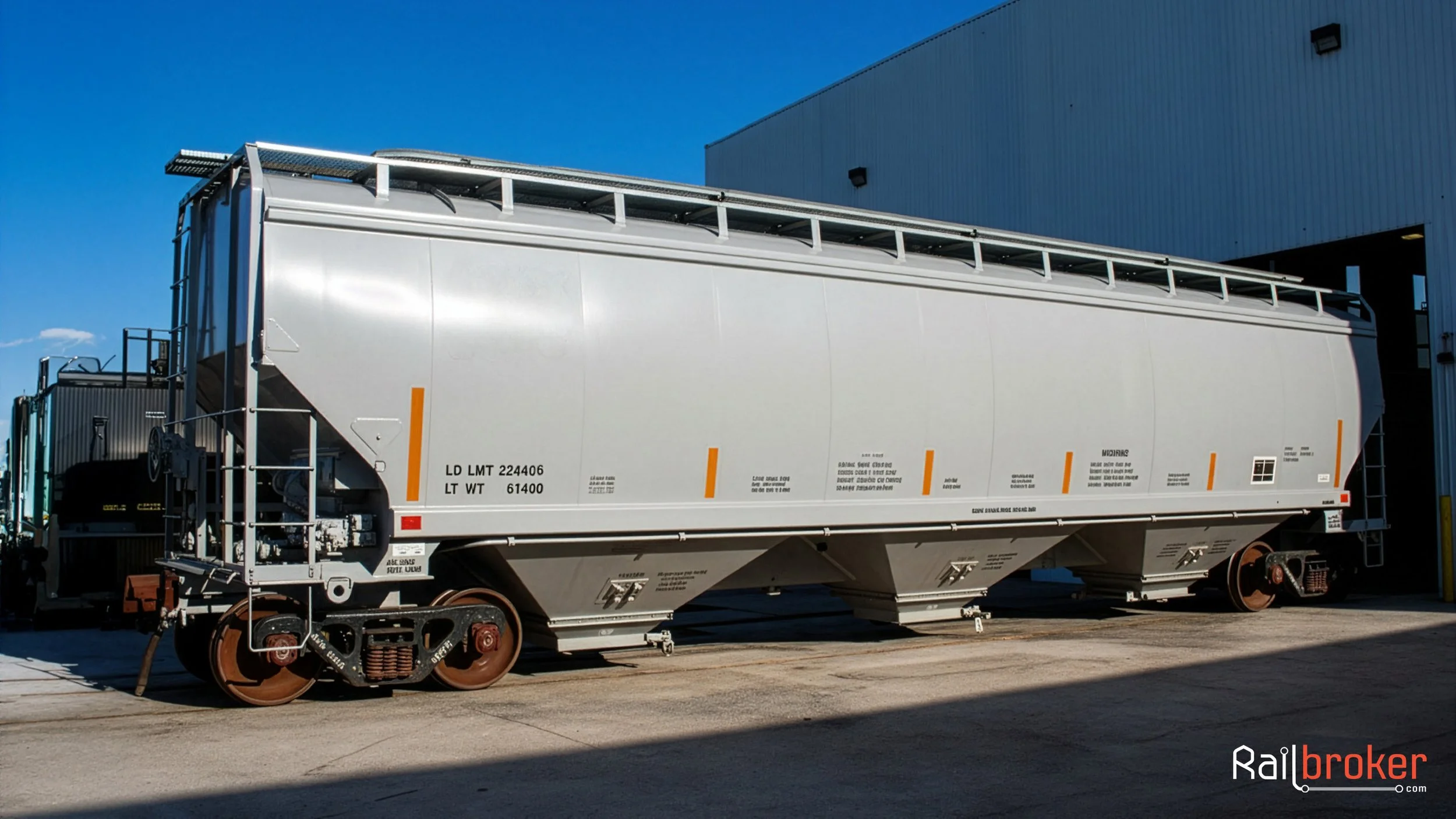
Covered hoppers are the most common railcar type in North America—roughly 29% of the entire revenue-earning fleet. They haul everything from grain and cement to plastic pellets and carbon black. But "covered hopper" is a broad category, and the differences between subtypes matter more than most first-time lessees realize.
A grain hopper won't work for cement. A cement car won't work for plastic resin. And leasing the wrong car for your commodity means contamination risk, unloading problems, or paying for features you don't need.
Here's what you need to know about covered hopper types, how they match to specific commodities, and the key factors that drive equipment selection.
What Makes a Covered Hopper a Covered Hopper
At the most basic level, a covered hopper is an enclosed railcar with a roof, top-loading hatches, and bottom-discharge outlets. The roof and hatches protect the lading from weather and contamination—critical for commodities that would be ruined by moisture, dust, or exposure.
Beyond that shared design, covered hoppers vary dramatically in size, discharge mechanism, interior finish, and construction. Those differences exist because the commodities they carry have very different physical properties—density, flowability, value, and sensitivity to contamination all drive equipment design.
The three variables that matter most when matching a covered hopper to your commodity: capacity, discharge type, and interior lining.
Capacity: Small Cube vs. Large Cube
Covered hoppers generally fall into two broad size categories, and which one you need depends on whether your commodity is heavy or light.
Small-cube hoppers (roughly 2,700–3,500 cubic feet) are built for dense, heavy products. Cement, sand, roofing granules, and mineral products weigh out long before they fill a larger car. A smaller car with a high weight capacity makes the most efficient use of each shipment.
Large-cube hoppers (roughly 4,750–6,500 cubic feet) are built for lighter, bulkier products. Grain, plastic pellets, dried distillers grains, and similar commodities cube out before they weigh out—meaning the car fills up by volume before it hits the weight limit. Larger cubic capacity means more product per car and fewer cars per shipment.
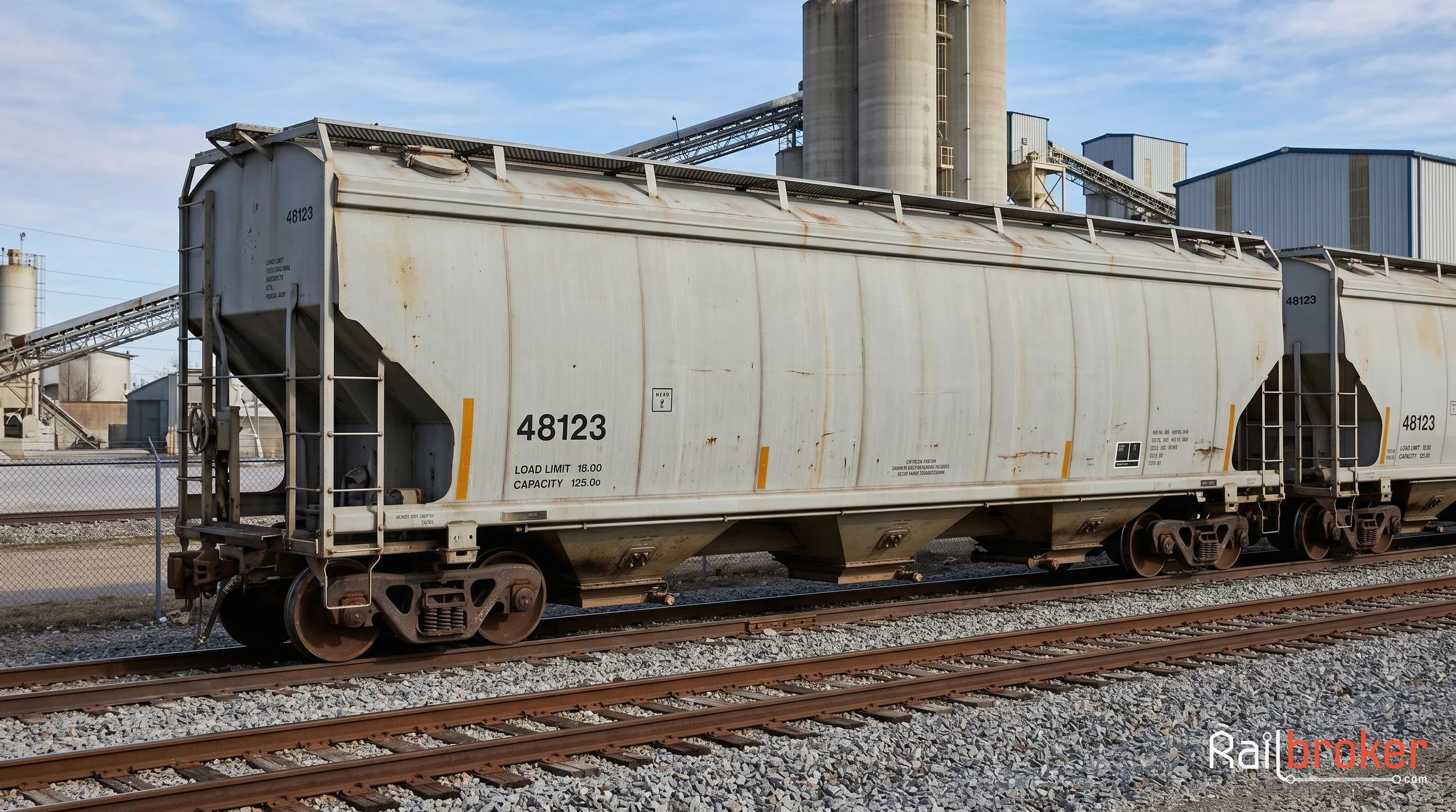
Within these broad categories, specific sizes have evolved for specific markets. The 4,750-cubic-foot hopper was the grain industry workhorse from the 1970s through the mid-1990s. Newer designs at 5,200–5,400 cubic feet have become the current standard for grain, with some builders now producing cars up to 6,500 cubic feet for lighter commodities like DDGs and meal products.
That evolution matters for sourcing. Tens of thousands of older 4,750-cubic-foot grain cars are approaching the end of their 50-year service lives and aging out of the fleet. New-build replacements are larger, meaning roughly four new cars replace the capacity of five retiring cars. If you're entering the grain market or expanding capacity, understanding this fleet transition is worth your time.
Gross Rail Load: 263K vs. 286K
Covered hoppers also come in two gross rail load ratings: 263,000 pounds and 286,000 pounds. The higher-capacity 286K cars carry roughly 11 more tons of product per load—a meaningful efficiency gain that adds up across hundreds or thousands of shipments.
Most new-build covered hoppers are 286K cars. But not every rail line can handle them. Light-density branch lines—common in agricultural regions—may have weight restrictions due to lighter rail, older ballast, or deferred tie maintenance. If your origin or destination is on a branch line, confirm the route can accommodate 286K equipment before committing to a lease.
Discharge Type: How the Car Unloads
How a covered hopper unloads is just as important as how much it holds. There are three primary discharge mechanisms, and each one serves different commodities and facility types.
Gravity Discharge
Gravity hoppers use sloped interior floors and bottom outlet gates to let product flow out under its own weight. The gates open, gravity does the work, and the product drops into receiving equipment below.
This is the simplest and most common discharge method. It works well for free-flowing granular products—grain, fertilizer, soda ash, sand, and similar bulk materials. Gravity cars are less complex mechanically, which generally means lower lease rates and less maintenance.
The catch: gravity only works for products that actually flow. Fine powders, hygroscopic materials, and products that pack or bridge during transit may not discharge cleanly from a gravity car.
Pneumatic Discharge
Pneumatic hoppers use air pressure to push product out of the car through discharge piping. The car is sealed, pressurized air is introduced, and the commodity moves through outlet pipes to receiving equipment at the destination.
This system is standard for plastic pellets, resins, PVC, and other petrochemical products where contamination control matters. The sealed discharge path keeps product clean and prevents exposure to outside elements during unloading. Interior surfaces are typically smooth and lined—often with epoxy or specialized coatings—to prevent product degradation and ensure clean flow.
Pneumatic cars cost more to build and maintain than gravity hoppers, and unloading takes longer. But for high-value commodities where product purity is critical, that cost is justified.
Pressure Differential Discharge
Pressure differential (PD) hoppers are a variation of pneumatic discharge, using internal air pressure—typically up to 15 PSI—to fluidize and move fine, powdery products. The closed-loop system connects to facility unloading equipment and uses controlled airflow to transfer product without exposing it to the environment.
PD cars are the standard for cement, fly ash, calcium carbonate, flour, bentonite, barite, and other fine dry-bulk materials that don't flow well by gravity alone. The pressurized system ensures complete discharge even for materials that would otherwise bridge or pack inside the car.
These are specialized pieces of equipment. PD hoppers require compatible unloading infrastructure at the destination—if your receiver doesn't have the right hookup, the car doesn't work regardless of how well it fits on paper.
Interior Linings: Protecting the Product (and the Car)
What's on the inside of a covered hopper matters as much as the outside dimensions. Interior linings serve two purposes: protecting the car from corrosive or abrasive commodities, and protecting the commodity from contamination by the car itself.
Unlined cars work for products that aren't sensitive to bare steel contact and won't corrode the car—grain, sand, roofing granules, and most mineral products move in unlined equipment.
Epoxy-lined cars are standard for fertilizer, certain chemicals, and products that would corrode bare steel or that require a cleaner interior surface. The lining prevents chemical interaction between the commodity and the car body.
Food-grade linings are required for sugar, rice, flour, malt, and other food products. These linings meet FDA and food-safety standards for direct contact with consumable goods. Food-grade cars also typically feature double outlet gates to reduce contamination exposure during unloading and sealed hatch designs for enhanced product protection during transit.
Specialty linings exist for specific applications—carbon black cars, for instance, use dedicated lining systems because the product is extremely fine, high-value, and sensitive to contamination.
Lining condition deteriorates over time. Cars require periodic re-lining—a process that involves grit blasting the interior to remove old coating, then applying new lining material. This takes a car out of service and costs real money. When evaluating a lease, understanding the lining condition and remaining useful life matters for your total cost.
Common Commodity-to-Car Matches
To put all of this together, here's how the major commodity groups typically match to covered hopper configurations:
Grain (corn, wheat, soybeans, barley): Large-cube gravity hoppers, 4,750–5,400+ cubic feet, 286K GRL, trough hatches, unlined. The bread and butter of the covered hopper fleet.
Fertilizer (urea, potash, ammonium nitrate, DAP/MAP): Medium to large-cube gravity hoppers, 3,500–5,200 cubic feet, epoxy-lined interior to prevent corrosion. Capacity depends on product density—potash is heavier and ships in smaller cars than urea.
Cement and fly ash: Small-cube pressure differential hoppers, 2,700–3,500 cubic feet, lined interior. Requires PD-compatible unloading facilities.
Plastic pellets and resin: Large-cube pneumatic discharge hoppers, 5,000–5,800+ cubic feet, smooth epoxy-lined interior, sealed discharge system. Product purity is paramount.
Sand and roofing granules: Small-cube gravity hoppers, 2,700–3,500 cubic feet, unlined, heavy-duty construction for abrasive service.
Food products (sugar, rice, flour, malt): Medium to large-cube cars with food-grade interior linings, double outlet gates, and enhanced sealing. Gravity or PD discharge depending on the product.
Carbon black: Dedicated pneumatic or PD hoppers with specialty linings, typically in captive service between producers and tire or rubber manufacturers.
DDGs, meal products, wood pellets: Large-cube gravity hoppers, 5,400–6,500 cubic feet, to maximize volume for these low-density commodities.
These are general guidelines—your specific product, loading and unloading infrastructure, route, and volume will determine the exact match.
Key Considerations When Sourcing Covered Hoppers
Match the Discharge to Your Receiver
This trips up more first-time lessees than almost anything else. Your car's discharge mechanism must be compatible with your receiver's unloading equipment. A pneumatic hopper showing up at a facility with only gravity unloading capability creates an expensive logistics problem.
Confirm compatibility at both ends of the journey—your loading facility and your customer's unloading facility—before committing to equipment.
Lining Requirements Are Non-Negotiable
If your commodity requires a specific lining, there's no workaround. An unlined car can't ship fertilizer without risking both the product and the car. A standard epoxy-lined car can't carry food-grade products. And a car with damaged or degraded lining may not be compliant for your intended service.
When evaluating available equipment, ask about lining type, condition, age, and the date of the last re-lining.
Size the Car to Your Product
Oversized cars waste money—you're paying a lease rate based on a capacity you'll never use if your dense product weights out at half the car's cubic volume. Undersized cars waste efficiency—more cars, more switching, higher per-unit costs.
The right match comes from understanding your product's bulk density and how it interacts with the car's cubic capacity and weight limit.
Don't Overlook Hatch Configuration
Covered hopper hatches come in three main styles: round hatches, trough hatches, and hybrid configurations. Your loading facility's equipment determines which one works.
Trough hatches run the length of the car and provide more flexibility for loading from conveyor-style systems. Round hatches are better for spot-loading from fixed spouts and provide tighter sealing. Not every hopper fits every loading facility—confirm compatibility.
The Fleet Is Transitioning
The North American covered hopper fleet is in the middle of a significant generational shift. Tens of thousands of older, smaller-capacity grain hoppers built in the 1970s and 1980s are aging out. They're being replaced by newer, higher-capacity cars—but not on a one-for-one basis. This creates both tightness in certain market segments and opportunities in others.
Understanding where the fleet is headed helps you make better long-term equipment decisions rather than just solving today's immediate need.
Finding the Right Equipment
Covered hoppers represent the largest segment of the North American railcar fleet, but that size masks significant complexity. Within the category, differences in capacity, discharge type, lining, hatch configuration, and gross rail load create dozens of distinct equipment subtypes—and each commodity has specific requirements that narrow the field.
Sourcing the right covered hopper means matching all of these variables to your actual operation. A railcar broker with visibility across multiple equipment sources can identify cars that fit your commodity, capacity, and infrastructure requirements—rather than forcing you to work backward from whatever happens to be available.
Need Covered Hoppers?
Railbroker sources covered hopper equipment across all major commodity categories—grain, fertilizer, cement, plastics, food-grade, and specialty applications. Whether you need a handful of cars for a specific customer or a larger fleet for ongoing operations, we can help match equipment to your requirements.
Questions About Covered Hopper Equipment?
Matching the right covered hopper to your commodity involves more variables than most shippers expect—discharge type, lining requirements, capacity, hatch configuration, and receiver compatibility all factor in. Railbroker works with shippers across North America to source equipment that fits actual operational needs.
If you're evaluating covered hopper options or need help understanding what equipment fits your operation, we can help.
Railbroker provides railcar leasing, sales, and logistics services across the United States, Mexico, and Canada. We specialize in tank cars, hoppers, gondolas, boxcars, intermodal equipment, and passenger railcars.